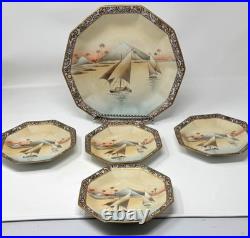
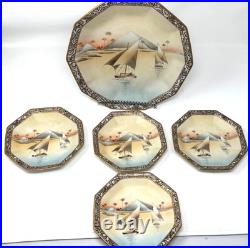
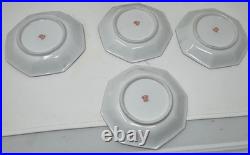
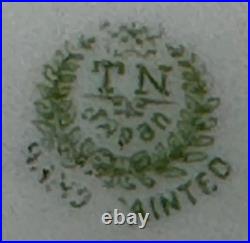

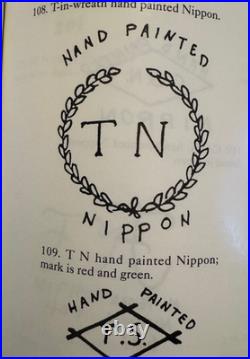
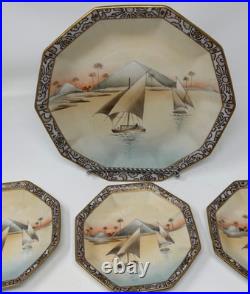

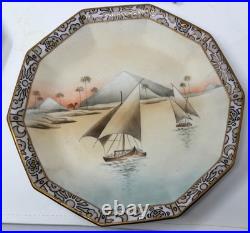

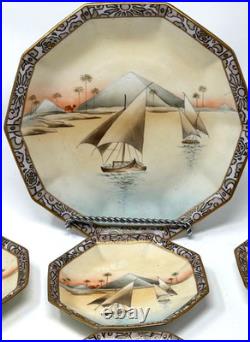


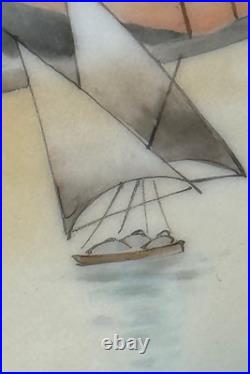
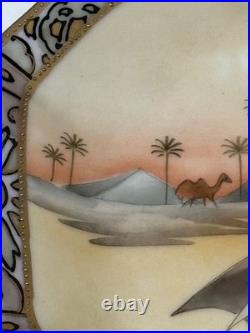
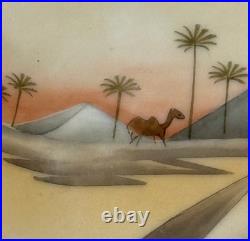
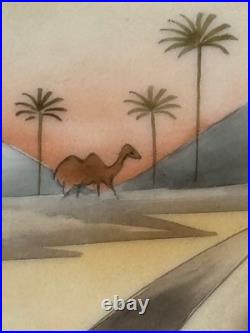
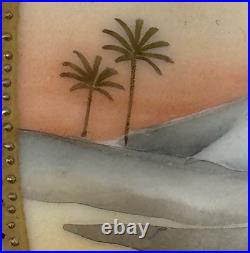


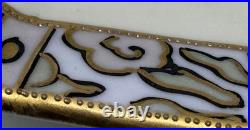

F rom the discovery of T utankhamun’s tomb by Howard Carter in 1922 when. Orientalist Egyptian revival began. Exquisite H and- P ainted N i ppon P orcelain B erry B owl S et. T he set showcases the intricate details of Egyptian revival art. A masterpiece of Asian antiques that will add elegance to any collection. T heir detailed gold edging and colorful floral beauty is undeniable. T his antique 5pc Berry Bowl set is in perfect condition. H and P ainted J apanese. N ippon P orcelain O rientalist E gyptian R evival scene with. Camels, palm trees, and pyramids are a perfect addition to any collection, and it will surely be cherished for years to come. M arking: Crown marking are as shown with’T’ and’N’ in the center. Researching came up with this. The “T N” could be “Tame & Nakamura” of “Moriyama style”. “Flower” mark in shape of five “M”. Is the Japanese word for Japan, and it refers to fine porcelain and china produced in Japan and exported to the United States primarily during the late 19th and early 20th centuries. Was used to comply with the McKinley Tariff Act of 1890, which required that goods imported into the United States be marked with their country of origin. The early period of Nippon china marked a golden era of creativity and craftsmanship in Japanese porcelain. During this time, Japanese artists and manufacturers were inspired by European styles but infused their works with traditional Japanese themes and techniques. The resulting pieces were beautiful and innovative, blending East and West in a way that. Was unique to this period. Post-1921 and WWII Era. After 1921, the U. Name of the country of origin. Leading to a decline in the use of the “Nippon” mark. However, some pieces continued to be marked with “Nippon, ” especially those intended for domestic use or markets other than the United States. During WWII, the production of fine porcelain in Japan shifted towards more utilitarian wares due to the war effort. Some Nippon-marked items from this period might exist, but they would likely be less common and different in style from the earlier, more ornate pieces. More often than not, these newer pieces would be marked with “Made in Japan” instead. Ribute to My Beloved Husband who died Sept. M now having to sell the treasures that my husband and I collected and displayed within our home for over 58 years to pay outstanding debts now that my Social Security was taken from me. At 79, I had no idea that the Social Security I worked for would be taken from me. Y husband, a US Army veteran, stationed in Germany from 1968 -69, where we were lucky to live for two years. While there, we bought a car and traveled throughout Europe purchasing unique items. Ubby became an International Corporate Executive, which gave us the opportunity to further travel throughout the U. Including Asian furniture and items, European antiques including Pottery, Furniture and Artwork. Collectibles include ceramics, my doll collection, books, jewelry, clothing and Americana collections. I try my very best to describe each item accurately by showing lots of photos. Please examine all the photos and description. I will answer all questions promptly. Nce I see your feedback, I will give one to you. F you have a problem with an item, PLEASE contact me, and I will try my best to work with you! How do I begin to explain a love so wonderful, so marvelous, that I hated for it to end? For 58 years, I was blessed with a marriage that was more than love, it was a promise that we both kept until his death. I answer all questions promptly. Hank you for looking at our unique treasures.